Architectural Millwork Stability: Equilibrium Moisture Content and Central Texas Climate Control
Central Texas millwork monitored since 2014 requires 6.5% to 8.5% equilibrium moisture content to prevent seasonal panel movement in Austin.
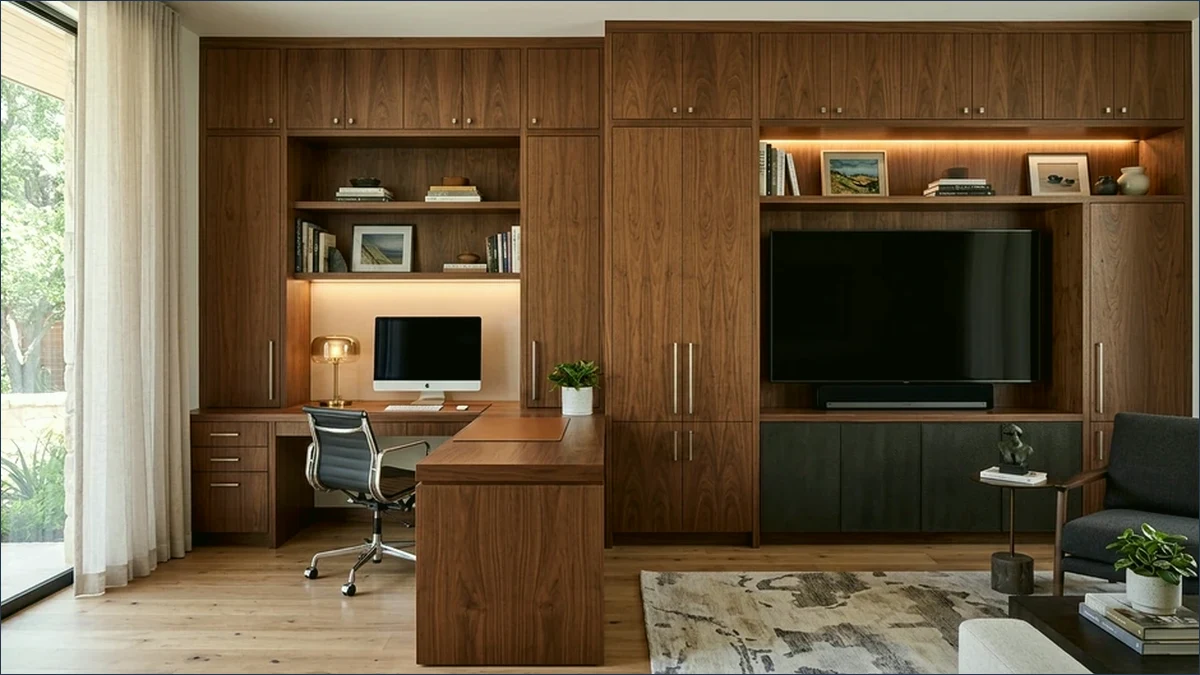
- Wood is hygroscopic and continuously exchanges moisture with indoor air until it reaches Equilibrium Moisture Content (EMC).
- Austin outdoor relative humidity averages 60% to 70%, while conditioned interiors typically run between 38% and 52% RH.
- Installing custom cabinetry before HVAC systems are active and drywall moisture has dissipated is the leading cause of joint telegraphing and door warp.
1. Hygroscopic Behavior and Equilibrium Moisture Content
Every hardwood species—whether solid black walnut, white oak, or hard maple—acts as a hygroscopic sponge, absorbing water vapor when ambient relative humidity rises and releasing it when indoor air dries out. The point at which wood neither gains nor loses moisture relative to its surrounding environment is called Equilibrium Moisture Content (EMC). For conditioned residences in Austin, Texas, where indoor temperatures remain near 70 to 74 degrees Fahrenheit and relative humidity hovers between 40 and 50 percent, target EMC falls between 7.7 and 9.2 percent.
Problems arise when lumber milled at 11 percent moisture content is installed inside an air-conditioned home sitting at 42 percent relative humidity. As the wood sheds roughly 3 percent of its internal moisture weight, cellular walls shrink tangentially across the grain. On a 24-inch-wide solid wood panel, a 3 percent moisture drop can produce nearly 1/8 inch of cross-grain shrinkage, stressing mitered corners, opening glue joints, and bowing unrestrained doors.
2. Central Texas Seasonal Humidity Swings
Central Texas presents a dual-climate challenge for architectural millwork. Spring and autumn mornings frequently bring outdoor relative humidity above 80 percent, while summer air conditioning and winter heating strips pull indoor humidity down toward 35 percent. If a custom home sits unconditioned during construction—or if wet trades such as concrete polishing, stucco, and drywall mudding are still curing—ambient interior humidity can spike above 75 percent. Bringing kiln-dried cabinetry onto a damp jobsite causes rapid surface swelling along exposed end grain.
3. Calculating Tangential vs. Radial Wood Movement
Wood does not shrink or swell equally in all directions. Longitudinal movement along the length of a board is negligible (typically 0.1 to 0.2 percent), which is why cabinet doors rarely change height. Cross-grain movement, however, is significant and splits into two axes: radial (across the growth rings) and tangential (parallel to the growth rings). Tangential movement is roughly twice as large as radial movement in most domestic hardwoods.
| Hardwood Species | Tangential Shrinkage (%) | Radial Shrinkage (%) | Estimated Width Change (per 12 in, 3% MC shift) |
|---|---|---|---|
| American Black Walnut | 7.8% | 5.5% | 0.095 in (tangential) / 0.067 in (radial) |
| North American White Oak | 10.5% | 5.6% | 0.128 in (tangential) / 0.068 in (radial) |
| Hard Sugar Maple | 9.9% | 4.8% | 0.121 in (tangential) / 0.059 in (radial) |
| American Cherry | 7.1% | 3.7% | 0.087 in (tangential) / 0.045 in (radial) |
4. Shop Design Strategies That Absorb Movement
Because wood movement cannot be stopped by force, precision cabinetmakers design joinery that accommodates seasonal expansion without structural failure. In five-piece shaker doors, solid stiles and rails are joined with cope-and-stick or mortise-and-tenon profiles, while the center panel floats freely inside a 3/8-inch groove cushioned by neoprene space balls. When humidity rises in May, the center panel expands into the groove rather than pushing the outer stiles apart.
- Measure every incoming lumber bunk with a pinless electromagnetic moisture meter calibrated for species density before rough milling.
- Seal all six faces of custom cabinet doors—including top and bottom edges—so moisture vapor enters and exits evenly, preventing cupping.
- Use elongated slotted screw holes when attaching solid-wood countertop islands or bench seats to metal or carcass frames.
- Specify balanced composite panels (veneer on both face and back of MDF) for full-height wardrobe and pantry doors over 60 inches tall.
Never fight wood movement with tighter clamps or thicker glue; engineer the joint so the timber can breathe without breaking the sightline.
5. Post-Installation Homeowner Care
Once custom cabinetry is installed in an Austin residence, maintaining stable indoor relative humidity between 38 and 52 percent preserves both finish integrity and door alignment. Whole-home dehumidifiers integrated into variable-speed HVAC systems prevent summer moisture spikes, while gentle damp-cloth wiping without standing water protects edge-banding seams around sinks and dishwashers.
Technical Questions & Answers
What is the ideal indoor humidity for custom wood cabinets in Austin?
Maintaining indoor relative humidity between 38% and 52% at normal room temperatures keeps wood near 7% to 9% equilibrium moisture content and minimizes seasonal movement.
Why do cabinet doors warp if installed before air conditioning is turned on?
Unconditioned jobsites with curing drywall or concrete often exceed 75% humidity, causing kiln-dried doors to absorb moisture unevenly and cup once the HVAC dries the house.
Does sealing both sides of a cabinet door really prevent warping?
Yes. Applying equal sealer and topcoat layers to the front, back, and all four edges slows and balances moisture vapor exchange across both faces of the panel.
Why do painted MDF doors show hairline cracks at shaker joints in winter?
Solid wood rails shrink slightly across their width during dry winter heating months, while MDF center panels remain static, stressing rigid paint films at the seam.
Related Craft Records
Austin Custom Cabinetry & Architectural Millwork Directory
Distinctive Woodcrafts Austin has documented residential millwork tolerances since 2014, tracking 18mm box geometry and 2026 AWI
Hardwood Species, Veneer Cuts & Finish Systems Index
Evaluating 6 core hardwood species and 4 veneer cuts since 2014, this 2026 material ledger pairs grain geometry with Austin
Frameless vs. Inset Cabinet Joinery: Structural & Clearance Analysis
Comparing 32mm frameless boxes and beaded inset frames since 2014, this 2026 audit measures storage gain, reveal tolerances, and