Specifying Rift-Sawn Walnut & White Oak Cabinetry: Grain, Core & Finish
Documenting rift-sawn walnut and white oak specs since 2014, this 2026 guide details 0.6mm veneer matching, NAUF cores, and UV finish retention.
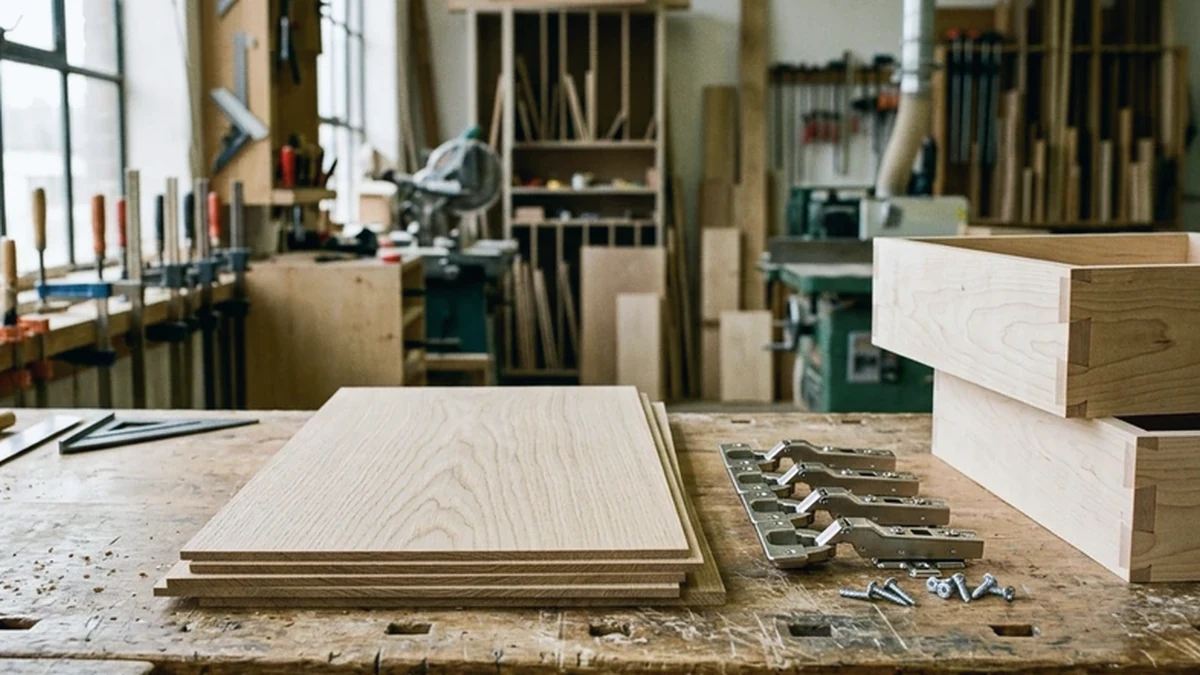
- Rift-sawn cuts yield only 15% to 20% of a log, making them more costly than plain-sliced veneers due to milling waste and strict grain sorting.
- Sequence-matched flitches ensure continuous vertical or horizontal grain flow across adjacent kitchen doors, drawers, and tall pantry panels.
- Specifying 1.5mm to 2.0mm thick solid wood edge banding prevents chipped corners on high-traffic island drawers.
- Waterborne 2K polyurethane topcoats protect natural white oak from ambering while preserving a raw, low-sheen tactile surface.
Why Rift-Sawn Cuts Dominate Modern Austin Interiors
Across contemporary Austin residential architecture, rift-sawn black walnut and rift-sawn white oak remain the benchmark materials for modern kitchens, floating vanities, and architectural wall paneling. As noted in /cabinet-gallery.htm and /veneers-definitions.htm, the appeal lies in geometry: unlike plain-sliced (flat-cut) timber that produces wide, sweeping cathedral arches, rift-sawn timber is milled perpendicular to the growth rings at a precise 30-to-60-degree angle. This orientation eliminates busy figure and suppresses the prominent medullary ray fleck seen in quarter-sawn oak, leaving tight, parallel vertical lines.
Because rift sawing requires rotating the log or cant repeatedly on the mill—or slicing pre-squared flitches in specialized veneer mills—yield drops to roughly 15% to 20% of the raw timber volume. That lower yield explains why rift-sawn white oak and black walnut carry a material premium over plain-sliced alternatives. When installed across a 16-foot kitchen elevation, however, linear rift grain creates calm visual continuity that complements natural limestone, honed quartzite, and minimalist steelwork.
Veneer Thickness, Matching Methods & Edge Banding
Commercial architectural panels typically use 0.6mm (1/42-inch) sliced face veneers hot-pressed onto a stable core, whereas custom shop-sawn veneers may reach 1.5mm to 3.0mm for deep profiles or heavy sanding tolerance. Regardless of thickness, how those veneer leaves are arranged on the panel determines whether a kitchen looks cohesive or patchwork. Four primary specification parameters govern every veneer order:
| Specification Parameter | Standard Shop Option | Architectural / Sequence Option | Visual & Structural Impact |
|---|---|---|---|
| Leaf Matching Method | Slip-match (uniform orientation) | Book-match or Sequence-match | Controls light reflection and continuous grain flow |
| Face Veneer Thickness | 0.6mm (1/42-inch) rotary/sliced | 1.5mm shop-sawn architectural | Determines sand-through safety and repairability |
| Core Substrate | 3/4-inch domestic veneer core | 3/4-inch NAUF MDF or combi-core | Prevents tall door bow and core telegraphing |
| Edge Banding | 0.5mm PVC or pre-glued veneer | 1.5mm to 2.0mm solid wood edge | Resists impact chipping on dishwasher & trash pull-outs |
Controlling Grain Continuity Across Doors and Drawers
To achieve continuous vertical grain from a bottom toe-kick drawer up through an 8-foot pantry door, cabinetmakers cut all fronts for a given elevation from a single numbered sequence of 4x10-foot or 4x12-foot sheets. Each saw kerf—roughly 3mm wide—must be accounted for in the CAD cut-list so the grain alignment does not visually jump across drawer gaps. Horizontal grain matching, popular in modern walnut vanities and media consoles, runs leaves across the width of the cabinet bank instead of vertically, emphasizing long horizontal sightlines. When island waterfalls or appliance panels wrap around corners, mitered 45-degree edge returns keep the same sequence-matched flitch flowing cleanly from the front elevation onto the exposed end panel without breaking the grain line.
Substrate Engineering: NAUF MDF vs. Veneer-Core Plywood
A common misconception is that plywood is always superior to MDF for cabinet doors. While 7-ply or 9-ply domestic veneer-core plywood excels in structural cabinet carcasses—holding screws tightly and resisting water damage near sink bases—its layered wood plies can telegraph subtle ripples through thin 0.6mm rift-sawn veneers under raking sunlight. High-density NAUF (No Added Urea Formaldehyde) MDF or combination-core (MDF crossbands over a veneer core) provides a dead-flat, glass-smooth face that keeps tall slab doors true within 1.5mm over 96 inches. For oversized 108-inch pantry doors, embedding concealed steel tension rods inside the hinge stile edge provides fine-tuned mechanical straightening without altering the exterior face grain.
- Specify NAUF MDF cores for full-height slab pantry doors and long floating vanity fronts.
- Use marine-grade or moisture-resistant exterior-glue plywood for sink-base boxes and wet bar interiors.
- Balance both faces of every veneered panel with a backer veneer of the same species or equivalent tension to prevent cupping.
- Store machined doors flat in climate-controlled shop racks for 48 hours between primer and topcoat curing.
Finish Chemistry for Raw-Look White Oak and Rich Walnut
Traditional oil-based varnishes turn white oak yellow-orange within months and dull the cool chocolate-purple undertones of unsteamed black walnut. Modern Austin specifications favor two-component waterborne polyurethane or clear catalyzed acrylic-urethane systems in 5-sheen (dead flat) to 15-sheen (matte) finishes. Adding a 1% to 2% white tint into the sealer coat on white oak neutralizes natural tannin warming, preserving the fresh-sanded raw timber look requested by contemporary architects on /blog and /intro.htm. Before full-scale spraying begins, Distinctive Woodcrafts Austin prepares two 12x12-inch sample boards from the actual project flitch—one brushed or sprayed with the baseline clear sealer and a second adjusted for jobsite lighting—so homeowners and designers can sign off under real North or West Texas window exposure.
Sequential flitch matching turns individual cabinet doors into a single architectural surface; the timber reads as one continuous volume rather than a grid of separate boxes.
Technical Questions & Answers
Can rift-sawn white oak be stained, or is it best left natural?
Rift-sawn white oak accepts both clear raw-look topcoats and custom wiping stains evenly because its tight vertical grain lacks the dense earlywood/latewood contrast of plain-sliced oak.
What is the difference between steamed and unsteamed black walnut?
Steaming darkens the pale sapwood to blend with the heartwood, creating uniform brown tones, whereas unsteamed walnut preserves richer purplish-chocolate hues and natural tonal variation.
How thick should solid wood edge banding be on veneered slab doors?
A 1.5mm to 2.0mm solid wood edge band applied with PUR (polyurethane reactive) adhesive provides durable impact resistance and allows a subtle 0.5mm eased radius without exposing the core.
Do veneered slab doors warp less than solid wood slab doors?
Yes. Solid wood slab doors wider than 12 inches will cup and twist under seasonal humidity changes, whereas balanced veneered panels over NAUF MDF or combi-core remain flat.
Related Craft Records
Austin Custom Cabinetry & Architectural Millwork Directory
Distinctive Woodcrafts Austin has documented residential millwork tolerances since 2014, tracking 18mm box geometry and 2026 AWI
Hardwood Species, Veneer Cuts & Finish Systems Index
Evaluating 6 core hardwood species and 4 veneer cuts since 2014, this 2026 material ledger pairs grain geometry with Austin
Frameless vs. Inset Cabinet Joinery: Structural & Clearance Analysis
Comparing 32mm frameless boxes and beaded inset frames since 2014, this 2026 audit measures storage gain, reveal tolerances, and