Frameless European Cabinetry: 32mm System Geometry, Carcass Joinery, and Reveal Tolerances
Frameless Euro-box joinery documented since 2014 relies on 32 mm boring centers and 2.0 mm door reveals for maximum interior storage.
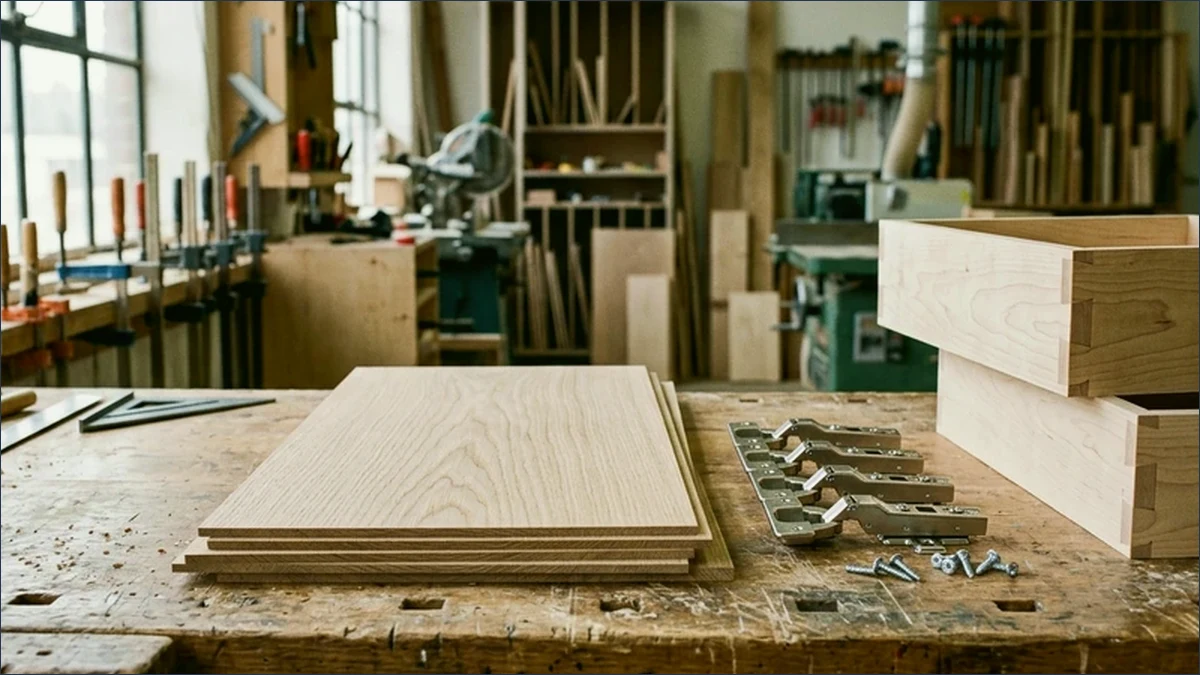
- Eliminating the traditional 1.5-inch face frame increases usable drawer and cabinet opening width by up to 15 percent.
- The 32 mm system standardizes shelf pin holes, hinge plates, and drawer slide mounting on exact 32 mm increments from a 37 mm front setback.
- Tight 2.0 mm to 3.0 mm door reveals require CNC nesting accuracy within +/- 0.15 mm and 6-way adjustable European hinges.
1. Structural Mechanics of Frameless Full-Access Casework
Frameless cabinetry—commonly termed European or full-access construction—removes the solid-wood face frame attached to the front of traditional American boxes. Instead, the structural integrity of the cabinet rests entirely on the thickness, density, and joinery of the side panels, deck, top stretchers, and solid back panel. Because there is no center stile or overhanging face-frame lip obstructing the opening, homeowners gain 10 to 15 percent more usable interior width per cabinet bay, a decisive advantage in compact urban kitchens and custom walk-in closets.
In custom shops across Austin, frameless carcasses are milled from 19 mm (3/4-inch) pre-finished maple plywood, melamine-faced particleboard, or 18 mm Baltic birch. Unlike mass-produced boxes held together by 1/8-inch stapled hardboard backs, custom architectural Euro-boxes incorporate a full 1/2-inch or 3/4-inch captive back panel rabbeted or dadoed into the sides. This rigid back prevents racking during delivery and installation and provides continuous structural screw-anchoring directly into wall studs.
2. The 32mm System Grid and Hardware Indexing
Precision frameless cabinetry operates on the international 32 mm system, a mathematical grid established to standardize boring patterns for shelf supports, concealed cup hinges, and full-extension drawer runners. Vertical rows of 5 mm holes are drilled on exact 32 mm centers, positioned 37 mm back from the front edge of the cabinet side panel. This 37 mm setback aligns directly with the mounting holes of European cruciform hinge plates and undermount drawer slide brackets, eliminating field measurement errors.
When combined with CNC point-to-point boring or nested-base routing, every carcass panel leaves the machine floor with repeatable tolerances within plus or minus 0.15 mm. That precision ensures that heavy drawer banks—capable of carrying 100 to 150 pounds of cast-iron cookware—glide smoothly without binding or racking across the cabinet opening.
3. Case Joinery: Dowels, Confirmat Screws, and Lock Miters
Because frameless boxes rely on side-to-deck connections without a face frame to tie the corners together, joint strength is paramount. Custom millwork shops select between fluted hardwood dowels glued under hydraulic clamping pressure, Confirmat structural screws, or CNC-milled blind dadoes reinforced with biscuit or domino tenons. Each method offers distinct advantages depending on whether the cabinet side is an exposed finished end or concealed inside a run.
| Joinery Method | Fastener / Tenon Spec | Exposed End Suitability | Shear Load Performance |
|---|---|---|---|
| Glued Fluted Hardwood Dowels | 8 mm x 35 mm beech dowels | Excellent (no visible fasteners) | High when clamped square |
| Blind Dado + Glue + Staples | 6 mm deep dado into 19 mm side | Good (requires finished end skin) | Very High (mechanical shelf support) |
| Confirmat Structural Screws | 7 mm x 50 mm steel sleeve screw | Concealed runs only | Very High (resists pull-out) |
| Lamello Clamex Connectors | 14 mm CNC-milled biscuit slot | Excellent (knock-down capable) | High for oversized tall units |
4. Managing 2mm Reveals and 6-Way Hinge Calibration
The visual signature of modern frameless cabinetry is the razor-thin 2.0 mm to 3.0 mm gap—known as the reveal—separating every door and drawer front. Achieving uniform reveals across an entire kitchen wall requires strict control over door thickness, edge-banding consistency, and hinge geometry. Concealed 110-degree European cup hinges (typically bored with a 35 mm cup diameter at 13 mm depth) provide 6-way independent adjustment: height (+/- 2 mm), side-to-side overlay (+/- 2 mm), and depth (+3 mm / -2 mm).
- Specify 19 mm (3/4-inch) minimum side panels to prevent screw pull-out on heavy tall pantry doors.
- Maintain a 3.0 mm horizontal reveal between stacked drawer fronts to allow clearance for finger pulls or integrated J-channels.
- Use 155-degree zero-protrusion hinges inside tall pantry cabinets fitted with roll-out trays so trays clear the open door.
- Install integrated toe-kick levelers rated at 300+ pounds per leg to compensate for uneven concrete slabs in Austin homes.
In frameless cabinetry, the reveal is the design: a 1 mm drift across a three-bank drawer stack immediately disrupts the architectural rhythm of the entire kitchen.
5. Installation Anchoring and Floor Leveling
Even the most accurate CNC-milled cabinet box will twist if bolted directly onto an out-of-level slab without shimming. Central Texas foundations frequently exhibit 6 mm to 12 mm variations across a 15-foot wall run. Installers establish a laser-leveled datum line at 34.5 inches above the highest floor point, set adjustable cabinet levelers or scribed ladder bases, and shim behind wall cleats before driving structural washer-head screws into studs. Final hinge and drawer-front calibration occurs only after stone countertops are fully seated and weighted.
Technical Questions & Answers
Are frameless cabinets less sturdy than face-frame cabinets?
No. Custom frameless cabinets use thicker 3/4-inch box walls and full 1/2-inch or 3/4-inch structural backs, providing equal or greater rigidity than 1/2-inch framed boxes.
What is the standard door gap in frameless modern cabinetry?
The standard reveal between adjacent doors and drawers in custom frameless cabinetry is 2.0 mm to 3.0 mm (roughly 3/32 to 1/8 inch).
How much extra storage does frameless construction provide?
Removing the 1.5-inch face frame stile and lip typically yields 10 to 15 percent more usable drawer width and unobstructed cabinet opening space.
Why do custom shops use 32mm line boring?
The 32 mm grid standardizes shelf pin holes, hinge mounting plates, and drawer slide locations, ensuring repeatable alignment and easy future hardware adjustments.
Related Craft Records
Austin Custom Cabinetry & Architectural Millwork Directory
Distinctive Woodcrafts Austin has documented residential millwork tolerances since 2014, tracking 18mm box geometry and 2026 AWI
Hardwood Species, Veneer Cuts & Finish Systems Index
Evaluating 6 core hardwood species and 4 veneer cuts since 2014, this 2026 material ledger pairs grain geometry with Austin
Frameless vs. Inset Cabinet Joinery: Structural & Clearance Analysis
Comparing 32mm frameless boxes and beaded inset frames since 2014, this 2026 audit measures storage gain, reveal tolerances, and