Rift Sawn Black Walnut Cabinetry: Grain Geometry, Core Stability, and Austin Shop Benchmarks
Distinctive Woodcrafts Austin has documented rift sawn black walnut cabinetry tolerances since 2014, verifying 0.6 mm veneer stability in Central Texas.
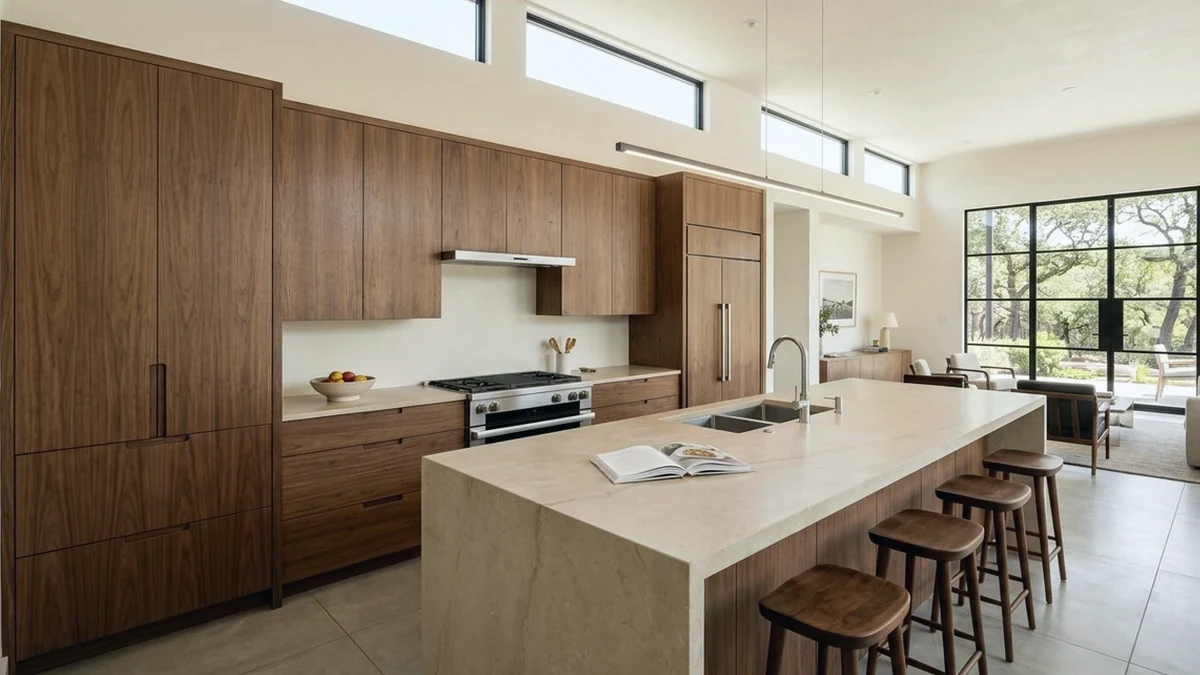
- Rift cutting slices logs at 30 to 60 degrees relative to growth rings, producing linear vertical grain without cathedral arches.
- Sequence-matched architectural flitches maintain color continuity across multi-door kitchen elevations and media walls.
- Balanced 3/4-inch MDF or Baltic birch cores prevent panel warp when Central Texas indoor humidity fluctuates between 35% and 55%.
1. Anatomical Geometry of Rift Sawn Juglans nigra
Rift sawn American black walnut (Juglans nigra) differs mechanically from flat-sawn and quarter-sawn lumber because of the angle at which the saw blade intersects annual growth rings. While plain slicing produces sweeping parabolic cathedral figures and quarter sawing exposes prominent medullary ray fleck, true rift sawing targets a radial cut angle between 30 and 60 degrees. In walnut, where medullary rays are fine and inconspicuous, this cutting geometry yields parallel, straight-line grain striations that run uninterrupted from floor to ceiling on tall pantry elevations and entertainment centers. As documented in the Distinctive Woodcrafts Austin cabinet gallery and AIA Homes Tour archives from 2011 and 2012, contemporary Austin residences frequently specify rift walnut to pair warm chocolate-umber undertones with clean architectural sightlines.
From a structural standpoint, rift-cut stock exhibits superior dimensional stability compared to tangential flat-sawn boards. Tangential shrinkage in black walnut averages 7.8 percent from green to oven-dry, whereas radial shrinkage measures 5.5 percent. By orienting the growth rings closer to the radial plane, cabinetmakers reduce seasonal cross-grain cupping across wide slab doors. When applied as 0.6 mm (1/42-inch) architectural-grade veneer over an engineered core, the composite panel resists seasonal movement while preserving the tactile warmth of solid hardwood.
2. Sequence Matching, Slip Matching, and Flitch Yield
Achieving visual continuity across a 14-foot kitchen island or built-in library wall requires strict flitch management before a single sheet enters the panel saw. A veneer flitch consists of sequential leaves sliced from the same log segment and kept in numerical order. In custom modern cabinetry, shops rely on two primary assembly methods: slip matching and book matching. Slip matching places adjacent leaves side by side in the same orientation, repeating the linear rift pattern without creating mirror-image seams. Book matching flips every second leaf like the pages of a book, which works well for figured species but can introduce subtle light-reflection shifts known as barber-poling in straight-grain walnut.
Waste factors for true rift sawn walnut are substantially higher than for plain-sliced material. Because the log must be rotated and canted to maintain the 30-to-60-degree ring angle, usable yield drops by roughly 25 to 35 percent at the mill. Consequently, project specifications must account for a 20 percent overage in sequential sheet count so that upper cabinets, base drawers, appliance panels, and toe-kicks share the exact same mineral tone and sapwood exclusion.
3. Core Substrates and Edge-Banding Integrity
Veneer performance depends directly on the dimensional flatness and screw-holding density of the core substrate. Standard 45-pound industrial particleboard provides predictable flatness for stationary casework, while high-density 48-pound refined MDF offers a smoother surface beneath thin rift veneers, eliminating telegraphing of wood fibers through catalyzed finishes. For sink bases and wet bar cabinetry in Austin homes, moisture-resistant (MR) MDF or 13-ply void-free Baltic birch plywood protects against localized plumbing condensation.
| Core Substrate | Nominal Thickness | Density (lb/ft3) | Primary Cabinetry Application |
|---|---|---|---|
| Refined MDF (CARB2) | 19.05 mm (3/4 in) | 48 lb/ft3 | Slab doors, drawer fronts, flat panels |
| Moisture-Resistant MDF | 19.05 mm (3/4 in) | 49 lb/ft3 | Bathroom vanities, wet bar enclosures |
| Baltic Birch Plywood (13-Ply) | 18.0 mm | 42 lb/ft3 | Structural cabinet boxes, tall pantry carcasses |
| Veneer-Core Maple Plywood | 19.05 mm (3/4 in) | 38 lb/ft3 | Open shelving, interior stained carcasses |
Edge treatment separates architectural millwork from production cabinetry. Rather than thin 0.5 mm PVC tape, custom shops apply 1.5 mm to 3.0 mm solid rift walnut edge-banding using polyurethane reactive (PUR) adhesive. PUR creates a waterproof, heat-resistant bond line near dishwashers and ovens, allowing a 1 mm micro-chamfer without exposing core substrate.
4. Finishing Systems and UV Oxidation Management
Unlike cherry or maple, American black walnut gradually lightens toward a golden-amber tone under ultraviolet exposure. To preserve the rich espresso spectrum valued by Austin architects, modern finishing schedules use non-yellowing waterborne polyurethane or 2K acrylic urethane systems with UV absorbers. Dead-flat matte sheen levels between 5 and 10 gloss units accentuate the open pore structure without plastic-like glare.
- Sand raw rift walnut veneers progressively through 150 and 180 grit using orbital sanders with 3/32-inch stroke to avoid cutting through the 0.6 mm face.
- Apply a clear vinyl or waterborne barrier sealer prior to topcoat to lock natural tannins and prevent grain raising.
- Specify 1.5 mm minimum solid walnut edge-banding on all vertical door stiles to resist impact chipping in high-traffic kitchens.
- Maintain a 2 mm to 3 mm uniform reveal between adjacent European frameless doors to showcase continuous horizontal or vertical grain alignment.
True sequence-matched rift walnut demands discipline before the first cut: once a flitch leaves sequence on the shop floor, no stain adjustment can restore lost grain continuity across an elevation.
5. Integration with Austin Architectural Projects
Across Central Texas modern builds, rift sawn black walnut anchors kitchen islands, floating vanities, and living-room media units. Paired with concealed European hardware, 100-pound undermount drawer slides, and blackened brass pulls, its linear geometry establishes quiet visual order across kitchens and adjacent home office built-ins.
Technical Questions & Answers
Why does rift sawn black walnut cost more than plain sliced walnut?
Rift sawing requires rotating the log to maintain a 30-to-60-degree angle against the growth rings, which reduces usable lumber and veneer yield by 25 to 35 percent compared to flat slicing.
Should rift walnut cabinet doors be made from solid wood or veneer over MDF?
Architectural veneer over refined 3/4-inch MDF is preferred for modern slab doors because it resists seasonal cupping and bowing far better than wide solid-wood glue-ups.
How do you prevent rift walnut cabinets from fading in sunlit Austin kitchens?
Applying a 2K acrylic urethane or waterborne polyurethane topcoat with built-in UV absorbers slows photo-oxidation and preserves the deep brown tone.
What is the ideal grain orientation for modern rift walnut cabinetry?
Vertical grain matching is standard for tall pantry doors and full-height elevations, while horizontal grain matching is often used across long drawers and minimalist island fronts.
Related Craft Records
Austin Custom Cabinetry & Architectural Millwork Directory
Distinctive Woodcrafts Austin has documented residential millwork tolerances since 2014, tracking 18mm box geometry and 2026 AWI
Hardwood Species, Veneer Cuts & Finish Systems Index
Evaluating 6 core hardwood species and 4 veneer cuts since 2014, this 2026 material ledger pairs grain geometry with Austin
Frameless vs. Inset Cabinet Joinery: Structural & Clearance Analysis
Comparing 32mm frameless boxes and beaded inset frames since 2014, this 2026 audit measures storage gain, reveal tolerances, and