Plain Sliced White Oak Millwork: Cathedral Figure, Tannin Control, and Custom Kitchen Integration
Plain sliced white oak millwork tracked by Distinctive Woodcrafts Austin since 2014 demonstrates 12% lower moisture absorption when sealed with 2K finishes.
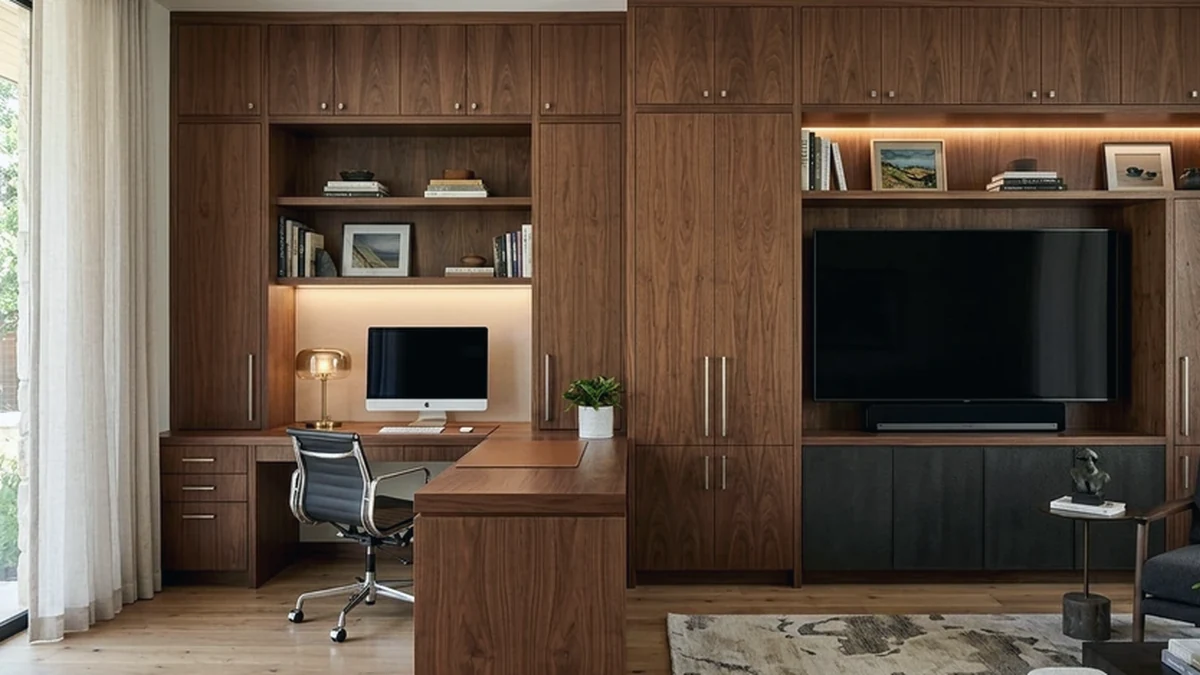
- Plain slicing (flat slicing) creates classic parabolic cathedral arches that bring organic movement to modern and transitional kitchens.
- White oak contains high concentrations of hydrolyzable tannins and tyloses, making it naturally water-resistant but reactive to iron and alkaline cleaners.
- Raw-look matte finishes require low-build acrylic or pigmented white-tint sealers to prevent ambering.
1. Cellular Structure of White Oak (Quercus alba)
North American white oak (Quercus alba) has remained a cornerstone of architectural millwork from traditional raised-panel libraries to contemporary European-style kitchens. Unlike red oak, whose open pores allow liquid penetration, white oak heartwood features microscopic bubble-like structures called tyloses that plug the vascular vessels. This anatomical trait gives white oak superior resistance to moisture vapor, making it well suited for kitchen islands, sculleries, and bathroom vanities highlighted in Distinctive Woodcrafts Austin project archives.
When plain sliced—also known as flat sliced—the veneer knife passes tangentially across the growth rings parallel to a line through the center of the log. This cut reveals sweeping parabolic loops called cathedral grain, flanked by tight parallel lines along the outer edges of each leaf. Whereas rift-cut white oak emphasizes strict linear uniformity, plain sliced white oak celebrates organic variation, softening monolithic cabinetry walls and complementing natural limestone, honed quartzite, and plaster surfaces.
2. Balancing Cathedral Figure Across Cabinet Elevations
Working with plain sliced white oak requires careful layout discipline so that cathedral arches do not clash or appear haphazardly stacked. Experienced cabinetmakers orient cathedral peaks pointing upward across upper and lower doors, maintaining a consistent directional rhythm. Book matching adjacent veneer leaves produces symmetrical diamond or hourglass patterns across double-door pantry fronts, while slip matching keeps each cathedral arch facing the same direction for a calmer, less formal aesthetic.
Color sorting is equally critical in plain sliced white oak. Natural logs span pale straw, warm honey, and muted olive-taupe heartwood. Without strict sapwood culling and flitch sequencing, adjacent cabinet doors can display noticeable tonal shifts once clear finish is applied. Specifying Grade AA architectural veneer flitches ensures consistent heartwood color and tight pore texture across every visible face.
3. Preventing Ambering in Natural White Oak Finishes
One of the most frequent specification challenges in modern white oak cabinetry is preserving the pale, raw-timber appearance after protective coatings are applied. Traditional oil-modified urethanes and standard conversion varnishes impart a warm yellow-amber cast that shifts white oak toward dated golden tones. To counteract this effect, custom finishing shops apply waterborne 2K polyurethane systems with 1 to 2 percent white pigment suspended in the base sealer, neutralizing natural ambering while leaving the open pore grain crisp and tactile.
| Finish System | Gloss Level (60-deg) | Color Shift on White Oak | Chemical Resistance |
|---|---|---|---|
| 2K Waterborne Acrylic Urethane | 5 to 10 GU (Dead Flat) | Minimal (retains raw pale tone) | High (KCMA compliant) |
| White-Pigmented Sealer + Matte Topcoat | 10 GU (Matte) | Neutralizes yellow/orange cast | High (resists wine and coffee) |
| Catalyzed Conversion Varnish | 20 to 30 GU (Satin) | Moderate warm ambering over time | Very High (heavy commercial use) |
| Hardwax Oil (2-Coat) | 10 to 15 GU (Natural) | Warm honey enhancement | Moderate (requires periodic renewal) |
4. Solid Wood Trim vs. Engineered Veneer Panels
In transitional shaker or inset cabinetry, cabinetmakers combine solid plain-sawn white oak stiles and rails (typically 3/4-inch to 7/8-inch thick) with 1/4-inch or 1/2-inch veneered center panels. Because solid oak expands and contracts across the grain with seasonal humidity shifts, floating the center panel inside a 3/8-inch dado groove with space balls allows the panel to breathe without splitting the frame joints. For full-overlay modern slab doors, pressing plain sliced veneer onto 3/4-inch refined MDF delivers absolute flatness across spans up to 96 inches tall.
- Use stainless steel or silicon bronze screws when mounting concealed hinges or decorative pulls on unsealed white oak.
- Acclimate solid white oak lumber to 6% to 8% moisture content in the Austin shop before milling stile-and-rail frames.
- Pair plain sliced white oak fronts with light maple or natural birch interior carcasses to maximize interior cabinet visibility.
- Specify 2 mm solid white oak edge-banding on slab doors to allow crisp eased edges without exposing dark glue lines.
White oak rewards restraint in the finishing booth: the goal of a modern matte topcoat is to protect the timber against kitchen moisture while appearing virtually invisible to the eye.
5. Architectural Longevity in Central Texas Homes
From magazine-featured renovations such as This Old House (March 2009) to contemporary Austin custom builds, plain sliced white oak endures because it bridges warm natural texture and clean structural geometry. When milled to tight tolerances, sealed against tannins, and fitted with commercial-grade European hardware, white oak cabinetry withstands decades of daily kitchen and bath use while maintaining dimensional precision.
Technical Questions & Answers
What is the visual difference between plain sliced and rift sawn white oak?
Plain sliced white oak displays sweeping parabolic cathedral grain arches, whereas rift sawn white oak shows straight, uniform vertical lines with no cathedral arches.
Why does white oak turn dark or blotchy near metal hardware?
White oak has high tannic acid content that reacts chemically with iron or carbon steel in the presence of moisture, forming dark blue-black stains.
Can plain sliced white oak be used in humid bathroom vanities?
Yes. White oak heartwood contains natural tyloses that block moisture penetration, and pairing it with moisture-resistant MDF cores and 2K polyurethane makes it highly durable in baths.
How do you keep white oak cabinets from turning yellow or orange?
Use a non-yellowing waterborne 2K acrylic urethane finish, optionally tinted with 1 to 2 percent white pigment in the sealer coat to offset natural wood warmth.
Related Craft Records
Austin Custom Cabinetry & Architectural Millwork Directory
Distinctive Woodcrafts Austin has documented residential millwork tolerances since 2014, tracking 18mm box geometry and 2026 AWI
Hardwood Species, Veneer Cuts & Finish Systems Index
Evaluating 6 core hardwood species and 4 veneer cuts since 2014, this 2026 material ledger pairs grain geometry with Austin
Frameless vs. Inset Cabinet Joinery: Structural & Clearance Analysis
Comparing 32mm frameless boxes and beaded inset frames since 2014, this 2026 audit measures storage gain, reveal tolerances, and